
Welcome to this edition of the Micro-Review Roundup, which for the most part comprises aggregate expansions of recent ramblings on my Twitter feed. And yes, I've been on a bit of a Horror kick recently, for anyone who somehow had any question on that. I suppose it's just that time of the month...
...by which I of course mean the recent full moon phase.
...by which I of course mean the recent full moon phase.
Film: Ted
Seth MacFarlane, 2012
An overly long and relatively restrained Family Guy episode with enough laughs in the first act to make the latter slog worthwhile. As always, could benefit from significantly more dark absurdism and significantly fewer 80s pop cultural references (though the balance of non-sequitur sequences is just about right this time). With a revamped second half, some much-needed editing, and more directorial experience from MacFarlane, this could have had the makings of a more notable comedy gem, but in its present form it's fairly disposable network TV fare scarcely worth comparing to animated raunch comedy classics like South Park: Bigger, Longer, Uncut or even the mixed success of The Simpsons Movie.
Grade: C
Film: Hellraiser
Clive Barker, 1987
A minor classic of Lovecraftian body horror equal parts the love child of Stephen King and David Cronenberg. Thoughtfully disturbing in its visceral dissection (pun intended, and forgive me for it) of human psychosexuality and the extremities of carnal desire, occasionally marred by some shaky cinematography and loose editing. Still as unsettling today as it ever was, and easily one of the greatest genre works of the 80s (not that its competition was particularly stellar).
As a bonus, also boasts the most frightening appearance of Plastic Jesus in cinematic history.
Grade: B
Film: Hellbound: Hellraiser II
Tony Randel (Heavy creative oversight from Clive Barker), 1998
That rarest of creatures, a Horror sequel worthy of its predecessor's dark legacy. Struggles with initially glacial pacing and some ill-conceived re-imaginings of Hellraiser's characters and creatures, but atones for those shortcomings with stronger cast performances, an unnerving new villain, and a uniquely memorable vision of hell. Where Hellraiser may torment your waking imagination, Hellbound is the fel stuff that will haunt your dreams. Bonus points for its practically overnight production and release within a year of its progenitor, all managed on a functionally microscopic budget.
Grade: B-
Francis Ford Coppola, 1992
By far the most faithful adaptation to Bram Stoker's original work, at least where tone is concerned, Coppola's Dracula remains relevant as perhaps the most wholeheartedly authentic visual realization of the Gothic genre to date. The film is a tour de force of lavish sensuality, oozing more style in every operatic scene than all the gallons of blood spilled in its breathtakingly brief 128 minutes running time. The cast is just as committed to the raw theatricality on view here, Gary Oldman entering the annals of vampiric legend as an utterly convincing incarnation of a passionate and tragically accursed Dracula, Anthony Hopkins devouring the scenery with all Van Helsing's eccentric excitability, and Tom Waits lurching about as the most entertainingly unhinged Renfield yet seen on screen. Keanu Reeves is the sole chink in the film's illustriously decorated armor, delivering in place of acting not only a constant mugging that would put the comic reaction shots of Hammer to shame, but also perfecting the most exquisitely tortured approximation of an English accent in living memory.
"LOVE NEVER DIES," promises the appropriately lush theatrical poster, and neither shall a film as lovingly devoted to its vision as this Gothic masterpiece.
Grade: A-
George Romero, 1968
The Ur-Zombie grandfather of them all, still just as unsettling in its high-concept exploitation even after fifty years of imitators. Brutish, nasty, and short, Romero's original remains as effective as it is primarily for its single-minded devotion to the desecration of all that is sacred in human society, playing both on the cultural fears of the Cold War and our more timeless aversions to death, decay, predation, destruction of identity, incest, cannibalism, and virtually every other primal fear or unthinkable taboo to haunt our psyches across the boundaries of community. A community which is so violated here as to leave generations pondering our own hypothetical reactions to such a loss of basic humanity.
Ever tense in its craft and composition, well-acted across the board (particularly by the now iconic Duane Jones), and marred only by its nonexistent effects budget and rampant misogyny (even for its time, judging by a few historic critical reactions), Night of the Living Dead remains the purest codification of its genre, surpassed in overall quality only by the tiniest handful of its successors, if ever at all.
Ever tense in its craft and composition, well-acted across the board (particularly by the now iconic Duane Jones), and marred only by its nonexistent effects budget and rampant misogyny (even for its time, judging by a few historic critical reactions), Night of the Living Dead remains the purest codification of its genre, surpassed in overall quality only by the tiniest handful of its successors, if ever at all.
"They're coming for you, Barbara. They're coming to get you, Barbara!"
Grade: A-
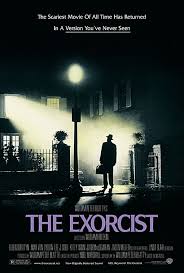 Film: The Exorcist
William Friedkin, 1973
William Friedkin, 1973
(And no, I will not be commenting on any of the differences in editions except to say that, as someone familiar with each, the cuts are not distinct enough that I would consider them worth contrasting in so small a space.)
On recently revisiting Friedkin's The Exorcist and Kubrick's The Shining after aeons, my initial reaction of re-appraisal was to note that, while both are near masterpieces of cinematic art, but both are minor failures as horror films. The Exorcist is tense, no doubt, paced with near perfection in the mounting terror not of the demon but of Chris MacNeil's (Ellyn Burstyn) increasingly helpless concern for her daughter's soul. I would hardly be the first to note that Pazuzu is not a particularly threatening villain from a secular perspective – certainly not compared to his Cenobite siblings or even the Paranormal possessor – but the horror at play is still somewhat effective empathically, again through the cypher of Burstyn's preeminent portrayal of a parent's deepest fears.
Though light on frights no one could claim The Exorcist is slim on style, and unlike the plethora of progeny it spawned it is just as profoundly substantial, both as well-crafted cinema and as a study of familial psychology. I care much less than I once did for the vague spiritual struggles of the auxiliary Father Damien Karras (Jason Miller) and his Catholic cohorts, too often recounted as the foci of the film, but their priestly presence certainly lends the climax its memorable dramatic weight. Nor can enough be said of Regan/Pazuzu's brilliantly executed joint performance by Linda Blair and Mercedes McCambridge.
Grade: B+
 Film: The Shining
Stanley Kubrick, 1980
Few times have I desired to love a film as much as I would like to love Kubrick's celebrated classic The Shining, but alas that I must be content to respect it. The Shining is a beautiful film no doubt, an exercise in compositional perfection out of which I could probably pick more favorite shots than any dozen other such films combined. From the jaw-dropping grandeur of its opening mountain credits to the skin-crawling spectacle of the flooding elevators to the unforgettable focal clash of the baby-blue Grady girls with the sickly-hued halls, The Shining is a display of Kubrick's mise-en-scène at its absolute most effective.
Such a pity, then, that it suffers more from Kubrick's clinical detachment than any of his other works to that date. So abstract is Kubrick in his surreal approach to setting that he leaves behind both his actors and the characters they are so desperately (over)working to present. Jack Nicholson's iconic turn as Jack Torrance is unforgettable, yes, but as entertaining as it is to watch the King of Crazy go axe-frenzy out of cabin fever, his performance is too ridiculous to find frightening on any serious level. Shelley Duvall's Wendy too is a mess of mewling hysterics, and the only moment of any palpable tension between the two – as well as the only truly terrifying moment in the film – is found when Jack is mercifully off-screen and Wendy discovers the horrible truth of his manuscript (which, of course, the viewer had surmised a near two-hour's time earlier in Nicholson's mad mugging).
As gorgeous as is Kubrick's imagery and as indelible is Wendy Carlos and Rachel Elkin's baroque score, The Shining is less successful as a sum narrative than as a collection of spectacularly effective imagery. And who knows, given that we're dealing with Kubrick here that may just have been the artistic intent all along.
Grade: A-
On recently revisiting Friedkin's The Exorcist and Kubrick's The Shining after aeons, my initial reaction of re-appraisal was to note that, while both are near masterpieces of cinematic art, but both are minor failures as horror films. The Exorcist is tense, no doubt, paced with near perfection in the mounting terror not of the demon but of Chris MacNeil's (Ellyn Burstyn) increasingly helpless concern for her daughter's soul. I would hardly be the first to note that Pazuzu is not a particularly threatening villain from a secular perspective – certainly not compared to his Cenobite siblings or even the Paranormal possessor – but the horror at play is still somewhat effective empathically, again through the cypher of Burstyn's preeminent portrayal of a parent's deepest fears.
Though light on frights no one could claim The Exorcist is slim on style, and unlike the plethora of progeny it spawned it is just as profoundly substantial, both as well-crafted cinema and as a study of familial psychology. I care much less than I once did for the vague spiritual struggles of the auxiliary Father Damien Karras (Jason Miller) and his Catholic cohorts, too often recounted as the foci of the film, but their priestly presence certainly lends the climax its memorable dramatic weight. Nor can enough be said of Regan/Pazuzu's brilliantly executed joint performance by Linda Blair and Mercedes McCambridge.
Grade: B+
Stanley Kubrick, 1980
Few times have I desired to love a film as much as I would like to love Kubrick's celebrated classic The Shining, but alas that I must be content to respect it. The Shining is a beautiful film no doubt, an exercise in compositional perfection out of which I could probably pick more favorite shots than any dozen other such films combined. From the jaw-dropping grandeur of its opening mountain credits to the skin-crawling spectacle of the flooding elevators to the unforgettable focal clash of the baby-blue Grady girls with the sickly-hued halls, The Shining is a display of Kubrick's mise-en-scène at its absolute most effective.
Such a pity, then, that it suffers more from Kubrick's clinical detachment than any of his other works to that date. So abstract is Kubrick in his surreal approach to setting that he leaves behind both his actors and the characters they are so desperately (over)working to present. Jack Nicholson's iconic turn as Jack Torrance is unforgettable, yes, but as entertaining as it is to watch the King of Crazy go axe-frenzy out of cabin fever, his performance is too ridiculous to find frightening on any serious level. Shelley Duvall's Wendy too is a mess of mewling hysterics, and the only moment of any palpable tension between the two – as well as the only truly terrifying moment in the film – is found when Jack is mercifully off-screen and Wendy discovers the horrible truth of his manuscript (which, of course, the viewer had surmised a near two-hour's time earlier in Nicholson's mad mugging).
As gorgeous as is Kubrick's imagery and as indelible is Wendy Carlos and Rachel Elkin's baroque score, The Shining is less successful as a sum narrative than as a collection of spectacularly effective imagery. And who knows, given that we're dealing with Kubrick here that may just have been the artistic intent all along.
Grade: A-
One Direction, 2012
So catchy it should be criminal, but the lovable kind of criminal like Robin Hood or the Artful Dodger, "What Makes You Beautiful" is an adorable chart debut by X Factor finalists One Direction and probably the least offensive ear worm of the year to date. WBYB is a pristine example of everything there is to like about boy bands – yes, even they have their redeeming qualities – what with its uplifting, heart-baring lyrics, its flawless rhythmic structure (for which, it has been noted, a great deal is owed to Pink), and an infinitely hummable bridge practically guaranteed to send all nearby victims bursting into the chorus whether willingly or unwillingly.
Yes, in terms of depth it's still the musical equivalent of a two-foot wading pool, but I challenge anyone to make it through a full listening without cracking a smile, or at least the hint of an acquiescent grin.
Grade: B+
"Flo Rida" (With emphasis on the quotes), 2011
Yes, this one is more than a little late, but I feel justified in reviewing it given that it's still topping charts and that no one seems to be calling this clown on his tripe. Content to prove himself the most shameless hack in the music industry, Flo Rida once again samples a refrain from an old classic (in this case Etta James's "Something's Got a Hold On Me" already resampled as Avicii's "Levels"), surrounds it with the most disposable flavors of rap on the radio, and calls it a day. Sure, the end product still retains some residual quality, but rather than support the cretin who led an entire generation to believe he was responsible for "You Spin Me 'Round," why not spare your own dignity and give this trash a pass in favor of a more honest club remix of the original Etta James?
Grade: C+ (Though artistic integrity here would merit an F for plagiarism, were we to carry the classroom metaphor.)


