subtext

Monday, February 15, 2016

Game of the Year #4: About a Girl

4. Her Story
Sam Barlow, 2015 (PC and iOS versions reviewed)
It’s that time of year again: the time when everyone who writes about games feels compelled to catalogue their experiences into top ten lists and award some lucky contestant the meaningless title of Game of the Year. It’s a fun way to collect our thoughts, reflect on how the medium advanced (or didn’t advance) since the last time around, and, most importantly, argue endlessly about why everyone else’s list is wrong. So without further ado, here’s the #5 title on my personal countdown: Sam Barlow’s Her Story.
I don’t suppose there’s much left to say about Sam Barlow’s breakout FMV hit that hasn’t been said, so I’ll keep it brief and reflect on my more recent follow-up experiences with the game as opposed to my original playthrough. For those who missed this high-profile indie gem or the months of heated discussion around it, Her Story is a digital detective simulator wherein you sift through an aging computer database of interrogative police video clips from 1994. Only the interviewee tapes are preserved - nothing of the detective’s (or detectives’) questions can be heard - and the archaic metadata transcription system means that, while you use simple word searches to sift through these videos for content, you are limited to viewing the top five results for any given term. Other than clicking around the virtual desktop and tagging videos with your own notes, this search bar is basically the game’s sole mechanic, but boy does it get a lot of mileage out of it.


Her Story unfolds in completely unique ways for every player due to this open-ended progression system and the near infinite number of possible search sequences that can be entered. I didn’t realize just how uniquely, however, until I began introducing the game to friends and discovering how utterly distinct the narrative can be depending on your pace and path of the discovery, the preconceptions individual players bring to the table, and sheer luck. As rich as these individual experiences can be, Her Story’s true potential shines nowhere more brightly than in a group setting. It’s engrossing to play the detective on your own and let yourself sink into the flow of your personal investigative narrative; it’s downright enthralling to do it as a party, feeding off one another’s speculative energy and bouncing your crazy theories and stratagems off one another like a bunch of drunken McNulties playing-acting couch Poirot. Pencils fly off of notepads, suspect profile are spouted, and the gaps between searches are filled with impassioned attacks or defenses on a particular character’s honesty or dishonesty, innocence or guilt, as all the strands of your thoughts and impressions begin to form the web that is your group’s Her Story narrative.


Sure, the FMV search mechanic is an “novelty,” but Her Story is so much more than the disposable diversion that label has come to represent re gaming mechanics. It’s a meticulously crafted, one-of-a-kind experience representing no technological evolution beyond a mid-90s adventure game but glowing with ingenuity in the way that simple tech is used to create something intellectually and emotionally investing.

Sunday, February 14, 2016

Firewatch With Me

Game: Firewatch
Campo Santo, 2016 (PC version reviewed)

Sometimes you just gotta get away from it all for a while, you know? Firewatch is a game about escape, both physical and emotional, and it just so happens to be a lovely little escape itself.  In a brilliant and moving interactive opening sequence, you learn you are Henry, a troubled man whose life is falling to pieces. Henry has opted to spend the summer of 1989 working as a fire lookout for a national park to escape that life and spend some time reflecting on his next move over the gorgeous vistas of Wyoming.

From the starting moment, Henry’s first major means of interacting with the world is exploration as you hike the two days to his lookout in time lapse, then get acquainted with your new tower home and time period through interaction with objects in the environment. His second means is by way of direct player choice, beginning with a series of life decisions about Henry’s history and followed by the radio dialogue with his new boss, Delilah, that forms the core of his human connection in the midst of the Wyoming wilderness. The real-time conversational system feels like a more subtle, natural, and omnipresent evolution of the “ABC” Telltale menu integrated with a more mature and believable variant of the BioWare dialogue wheel. It’s an intuitive and fluid way to anchor the player to Firewatch’s story and characters, augmented all the more by a near perfect set of vocal performances and some genuinely funny and touching writing.


Yes they are, Firewatch. Yes they are.

The third major means of player interaction, and the one that feels both most beholden to and iterative upon Gone Home, is the direct control of Henry’s body and his second-to-second physical choices in the world. Having just recently experienced SOMA for the first time, I was almost giddy to find so quickly another game that captures the tactile feeling of its controls, extending in design philosophy here to a minimalist UI and a Far Cry 2-style in-world map and compass. The physicality of Henry’s animations and his freedom of environmental manipulation also go a long way toward grounding the player’s sense of presence and investment in his story. Like Gone Home and SOMA, much of that object manipulation is used to read inscriptions or gather narrative clues, but most of it exists to further that sense of player presence by fleshing out Firewatch’s natural grandeur with lifelife (mostly human) details.


A man could get lost in this world. Especially if he has my sense of direction.

It’s just one of many ways in which Firewatch succeeds at the level both of, if you’ll forgive me, the forest and the trees. The natural grandeur is truly goddamn grand, making Firewatch a gorgeous game to explore and snap screenshots of, no doubt about it; the devs wink about this by quickly providing the player with a cardboard disposable camera with which to take in-game photos, yet another tactile anchor into the UI-free world. It somehow manages to evoke real awe at its colorful mountains and burning sunsets even while being hyper-stylized in a jagged, angular cartoon way reminiscent of Team Fortress and Wreck-It Ralph, particularly in the character design. It would be nice if your journey were a little less constrained to trodden paths, and the narrative progression through them a little less linear, but given its production limitations Firewatch provides a commendable degree of freedom to explore.


The only fire I need to watch for is the one you set in my heart.

Yet for all that big picture beauty, Firewatch’s true heart lies in the almost stream-of-consciousness flow of walkie-talkie dialogue between Henry and Delilah, to whom you can “Report” not only fires but a staggering number of verbal observations about the world. Mad Men’s Rich Sommer and The Walking Dead game’s Cissy Jones thoroughly sell their roles across thousands of lines of criss-crossing dialogue that shift shape and tone in impressively subtle ways depending on the player’s actions. Conversations and character outcomes are affected by choices as small as whether to pick up an abandoned bottle of whiskey or accidents as quotidian as taking a wrong turn to a dead end on your patrol, in addition to the slightly more obvious “big decisions” for which a Telltale game would’ve provided the reminder “Delilah will remember that.”


I’m happy for you, Firewatch, and I’mma let you finish. But first I’m gonna sit and stare a while.

I’m loathe to discuss details of these conversations and thereby spoil discovery of any of these little moments, so suffice it to say Firewatch, for all its tremendous sense of humor, goes some Deep Places and asks the player to question, along with its characters, some serious stuff about relationships, human needs, selfishness, personal responsibility, and social connection. It’s almost paradoxical that a game could manage to be such a surreal escape from real life while forcing us to confront some of its harshest realities and the very real consequences of escapism, but that’s kind of the point of Firewatch, or it would be if I were forced to say it has just one.*


You mean you’re actually gonna make me work to get places?

If Firewatch has one glaring flaw it’s that it doesn’t really deliver on all this emotional buildup. It crescendos to something of an anticlimax after unsuccessfully attempting to pull off Gone Home’s same narrative bait-and-switch, which now looks even more like a clever once-and-done “trick” of genre subversion that can never again be called upon with the same effect. There are other signs that development might have gotten a bit rushed in the final act, with environmental bugs showing their ugly faces for the first time, conversation becoming much more sparse for what feel like slightly contrived reasons, and narrative choices playing out in the finale in hasty and somewhat unsatisfying ways.


Don’t mind if I do.

Disappointing conclusion notwithstanding, Firewatch has occupied my thoughts almost constantly since the credit rolled. I’m tempted to hand-wring about its problems keeping it just shy of greatness or make some equally silly and premature judgment about its place in gaming history vis-à-vis release proximity and superficial similarities to something as affected as The Witness. The more honest truth is that I found Firewatch easy to love at its best and difficult not to recommend at its worst, and it doesn’t need favorable comparisons to a diametrically opposed game in order to shine.

* It doesn’t.  
Really liked it.

Wednesday, February 10, 2016

Game of the Year #5: Which Witcher Whipped Which Witch Hunter?

5. The Witcher 3: Wild Hunt
CD Projekt Red, 2015 (PC version reviewed)
It’s that time of year again: the time when everyone who writes about games feels compelled to catalogue their experiences into top ten lists and award some lucky contestant the meaningless title of Game of the Year. It’s a fun way to collect our thoughts, reflect on how the medium advanced (or didn’t advance) since the last time around, and, most importantly, argue endlessly about why everyone else’s list is wrong. So without further ado, here’s the #5 title on my personal countdown: CDPR’s The Witcher 3.
I have a strong bias in favor of interesting games. Not just good games, but games that push or break boundaries in novel ways. Games that take risks and diverge from formula. Games that aren’t afraid to be weird or to flout conventional design wisdom if it makes for a more uniquely engaging experience.

The Witcher 3: Wild Hunt is none of these things. There’s hardly a piece of it we haven’t seen a hundred times before. It’s an iterative evolution on The Witcher 2: Assassin of Kings, mostly in that it follows the trend of trading discrete levels or load areas in favor of an almost completely open-world map design - sometimes at the expense of detail and intentionality in the design of individual areas. The combat has been modified from an awkward hybrid of point-and-click MMORPG combat and a Diablo-style action RPG to an awkward hybrid of Arkham-style rhythm combat and direct input Souls combat. The interface and menus are are only slightly less byzantine and unwieldy than before, or just as unwieldy in different ways, an RPG vice we’ve less gotten used to than just learned to accept. The basic open-world RPG formula of “follow map to quest giver, follow map to quest cutscene, kill/gather quest MacGuffin, follow map back to quest giver” remains the sole script in play.

So why is something as uninteresting The Witcher 3 one of my favorite games of 2015? Because it knows what it is, it knows its strengths, and it throws money and manpower and talent at those strengths until they’re stronger than anything else like it. This is most immediately apparent in the production values: The Witcher 3 is a gorgeous game, not only in its breathtaking technical facsimile of real cities and real people, nor in its colorful art design and sense of haute-renaissance-meets-high-fantasy style, but in the sheer awe it generates through combination of these elements in a gigantic, vividly lifelike world. This fidelity constantly tempts you to stand in the middle of a city watching the crowds mill by with purpose that would put Assassin’s Creed to shame, or to stop and stare at a tangerine sunset at the end of a long day’s journey and enjoy the best melancholic orchestration a big studio budget can buy.


You might stop and take a moment to enjoy the view. Probably many moments.

The Witcher 3 finally delivers on the promise Oblivion made and broke a decade ago when it introduced us to a superficially huge and beautiful world that then immediately fell apart at the seams when we met its dead-eyed robot residents, mechanical encounters, and suffocating lack of personality or variety. The Witcher 3’s residents not only appear alive but act alive, both in their mundane habits and reactions and in their shockingly human expressions and dialogue when interacting with one another or with Geralt, our titular Witcher. The writing and acting aren’t themselves groundbreaking - we’ve seen similarly high quality in BioWare and Obsidian’s work for some time now - but combined with such stunning graphical fidelity and animation it all makes for an extraordinarily engaging experience in CDPR’s environments and with their characters.


You don’t need Ciri to solemnly swear she’s up to no good.

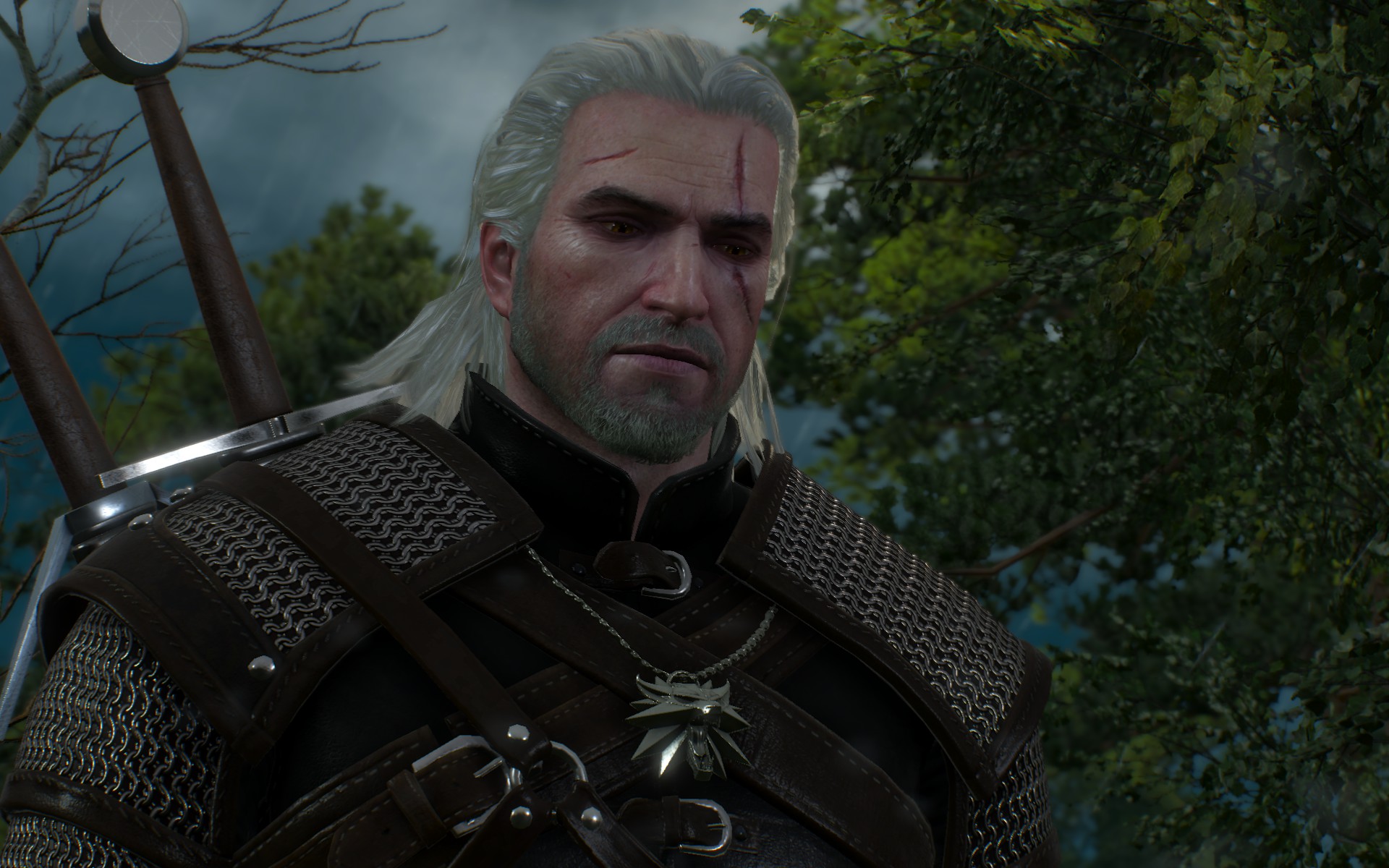
Geralt himself is transformed from the unrelatable, emotionless cypher he was in the previous titles to a genuine human being  (albeit a mutant one) simply through the subtleties of his expressions. A slight grimace at his mouth’s edges here, a glint in his eye or raised eyebrow there - each reveal something of the inner life of a person who’s not so devoid of feeling as he’d like the world to think. Nowhere is this seen more clearly than in Geralt’s relationship with and search for his adopted daughter Ciri, the driving central quest of the narrative as she flees from the Ringwraith-like Wild Hunt. We can speculate some meta reasons why fathers seem to have become the de facto protagonist of AAA games, but there’s no denying it carries tremendous emotional heft for a leading man as detached as Geralt had always been, and that it grounds the narrative in intimate realities in a way I wish more fantasy games would.


(Secretly a huge softie.)

That’s the Witcher 3’s core strength, really. It’s this vast and sprawling and epic thing, a dauntingly realized universe filled with more quests and characters than you could start or meet in a hundred hours. Yet for all that the game never loses sight of its humanity, even in its monsters. It’s as much the little things - the tiny touches of life - as the big ones that make The Witcher 3 great.